
Upper Back Tooth Implants in China: Sinus Lift Planning and Coordination
Explore clinician-led planning in China for upper back tooth implants, including sinus-area imaging, treatment alternatives, restorative design and follow-up.
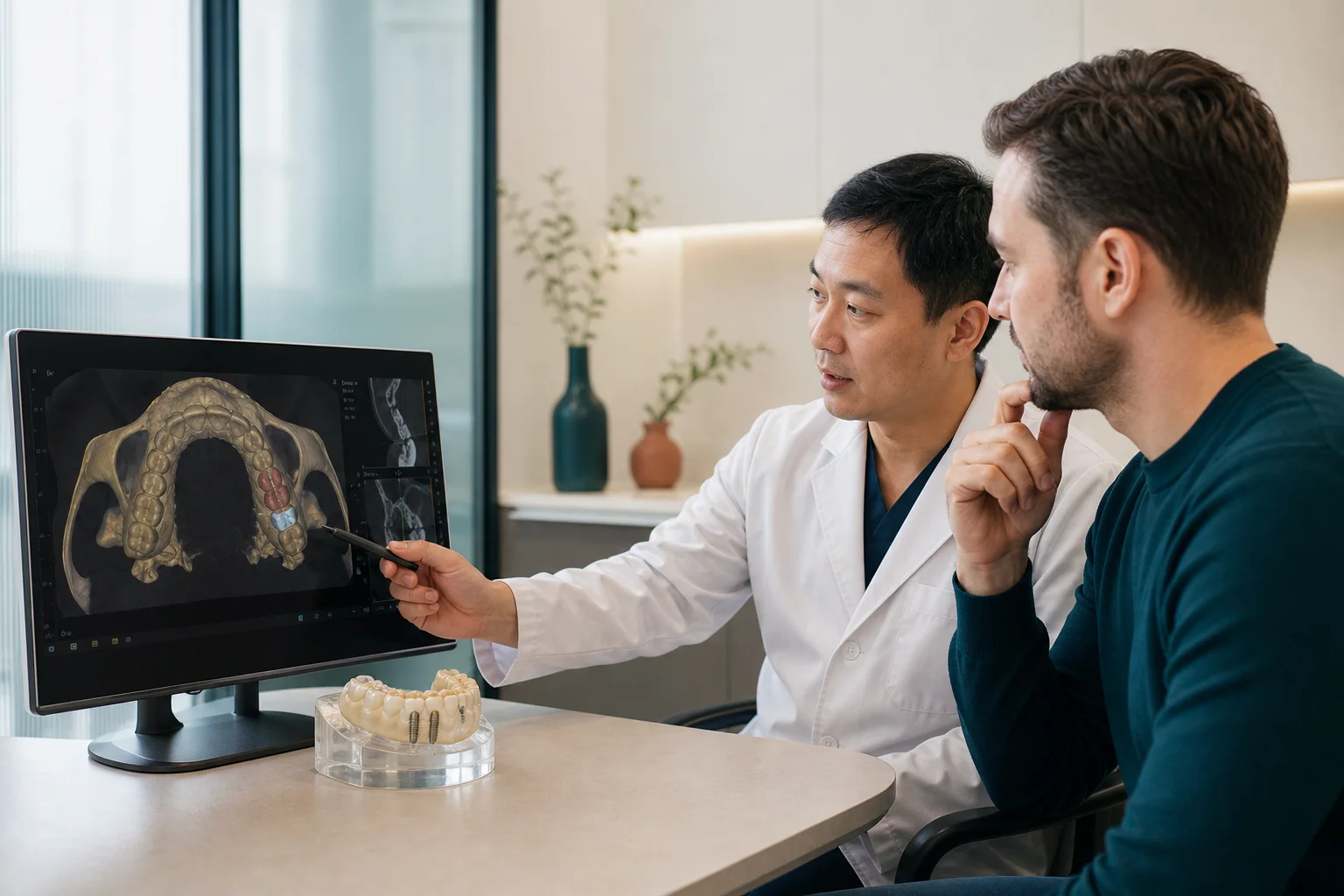
Replacing a missing upper back tooth with an implant can involve a question that does not arise in every part of the mouth: how much bone is available below the maxillary sinus. The sinus is an air-filled space above the upper premolars and molars. After teeth have been missing for some time, the amount and shape of bone in that area can vary. For some patients, the treating clinician may discuss a sinus-lift or sinus-grafting procedure as one possible way to create conditions for an implant. For others, a different implant approach, a bridge, a removable option or no replacement may be more appropriate.
China Dental Implants and Pinnacle Medical China coordinate practical planning for international patients considering an upper-jaw implant assessment in Beijing. Licensed partner clinicians are responsible for examination, imaging interpretation, diagnosis, surgical and restorative recommendations, consent and clinical care. Our role is to help organise records, appointment logistics and patient questions before travel. We do not decide from an X-ray alone that sinus surgery is necessary, promise a simultaneous implant placement or guarantee a treatment timetable.
Why upper back teeth need location-specific planning
An implant site is not defined only by the gap. The clinician also needs to consider the height and width of available bone, gum condition, the shape and position of the sinus, neighbouring teeth and roots, the bite, medical history and the planned final crown or bridge. Two patients who are both missing an upper molar can have very different options. A radiograph or three-dimensional scan may clarify whether there is enough bone for a proposed implant position and whether a sinus-related procedure needs to be discussed at all.
Our dental implant service overview explains why implant treatment begins with a clinical assessment and a final restorative goal. An implant is not the visible tooth by itself: the planned crown, bridge or denture, and the ability to clean and maintain it, are part of the original decision.
What a sinus lift may mean
A sinus lift is a surgical procedure that may be considered to create more bone below the upper-jaw sinus for implant placement. Depending on the clinical findings, a clinician may discuss carrying it out before implant placement or in the same surgical stage. These are not interchangeable promises. The decision depends on the anatomy, the quantity and quality of bone, the intended restoration, the patient’s health and the clinician’s judgement during planning.
Patients should be wary of a fixed online answer such as “you definitely need a sinus lift” or “your implant can definitely be placed at the same time.” Those claims can only be responsibly discussed after appropriate imaging and an in-person examination. A sinus procedure is elective, and the patient should understand its purpose, limitations, possible alternatives and the expected follow-up before giving consent.
Who may find this coordinated service useful?
This pathway may be relevant for adults missing one or more upper premolars or molars, patients who have been told that available bone may be limited in the upper back jaw, or patients whose prior implant plan mentioned a sinus lift, sinus graft or staged upper-jaw treatment. It can also help someone comparing an upper-jaw implant with a conventional bridge, a removable denture, a shorter implant, a different implant position or no tooth replacement.
It is not emergency care. Facial swelling, fever, trauma, uncontrolled bleeding, difficulty breathing or swallowing, severe rapidly worsening pain or a suspected spreading infection needs prompt local dental or medical assessment. Do not delay urgent care while arranging international treatment. A remote records review can organise questions but cannot diagnose an acute sinus or dental infection or determine whether an urgent procedure is needed.
Begin with records and the reason the tooth was lost
Before travel, patients can share recent X-rays or CBCT files where available, photographs, the history of extraction or tooth loss, previous bridge or denture records, any periodontal or root-canal history, and a description of current symptoms or chewing concerns. Medical history and medicines are also important. Smoking or vaping, diabetes, osteoporosis medicines, past radiotherapy to the head or neck, gum disease, sinus history and past implant treatment may affect what the clinical team needs to consider.
Records are helpful because they focus the first consultation; they do not replace diagnosis. Our dental implant records checklist for Beijing describes how imaging, dental history and health information support preliminary discussion without locking in a surgical plan.
The Beijing assessment: scan, mouth and final restoration together
At the clinic, the treating team may examine the gums, bite, neighbouring teeth, opposing teeth and available space for the planned restoration. They may recommend new digital scans, radiographs or three-dimensional imaging according to the case. The assessment can change the early idea: an implant site may be suitable without additional grafting, a sinus-related procedure may be considered, a staged route may be safer, or an implant may not be the preferred option.
Planning the final crown or bridge at the same time helps prevent a surgical-only approach. The team needs to understand the position of the planned tooth, contact with the opposing bite, cleaning access and the condition of adjacent teeth. Our bone-grafting service guide explains why a grafting discussion should remain connected to the final restorative plan, patient health and follow-up rather than being treated as a standalone add-on.
Compare alternatives before deciding on sinus surgery
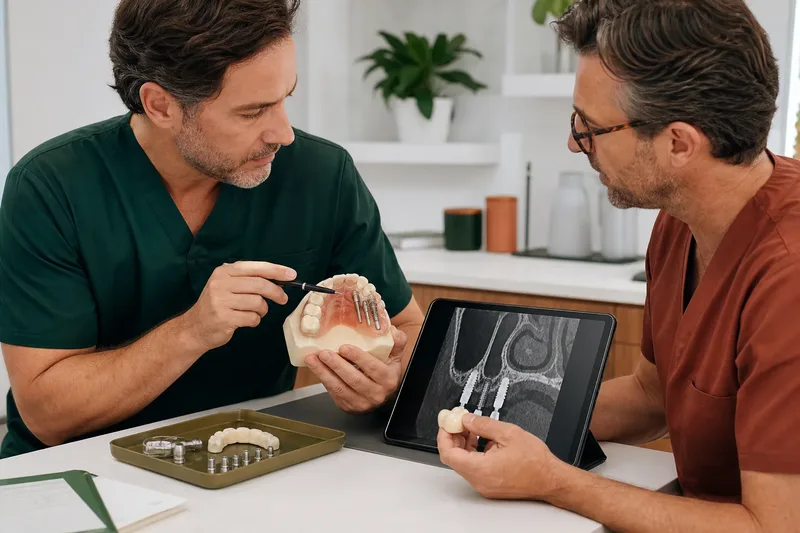
A sinus lift is not the only possible response to limited upper-jaw bone. Depending on the individual case, the treating clinician may discuss a different implant design or position, a shorter implant where appropriate, fewer implants supporting a different restoration, a bridge supported by adjacent teeth, a removable denture or accepting a stable space. Each alternative has its own implications for support teeth, bite forces, cleaning, repair and long-term review.
A useful consultation makes the trade-offs visible: what each path may require, which factors are still uncertain, and why a particular option is being recommended. Patients should not feel that a sinus lift is the default simply because it appears on an online quote. The clinician needs room to recommend a non-surgical or differently staged option if the assessment supports it.
Do not let flights determine surgical staging
Upper-jaw implant treatment can include assessment, a possible grafting or sinus-related stage, healing, implant placement, restorative records, a temporary solution and final restoration. Not every patient needs every stage, and the timing cannot safely be promised in advance. If the team proposes more than one visit, ask which decision points separate the visits, what could change after imaging or surgery, and what type of temporary replacement may be discussed.
Our dental implant timeline guide explains why surgical and restorative steps may be separated and why travel should follow the confirmed clinical pathway rather than a pre-set itinerary. The clinician’s post-operative and follow-up instructions take priority over general information online.
Follow-up and records should be planned before travel
Before leaving Beijing, patients should ask what clinic-issued treatment summary, imaging, implant-system records, restoration information and follow-up instructions will be provided. If treatment is staged, it should be clear what has been completed and what must be reviewed before the next step. A local dentist can be important for routine care or unexpected needs after return travel.
China Dental Implants and Pinnacle Medical China can help route non-urgent practical questions to the appropriate Beijing team and make appointment and document planning clearer. We do not interpret scans as a diagnosis, perform a procedure or guarantee how bone, gums or an implant will heal. Those decisions remain with the licensed treating clinicians after examination and informed consent.
Start with an upper-jaw implant review
If you are missing an upper back tooth and have been told a sinus lift might be relevant, begin with your records, health context and treatment goals. You can request an upper-jaw implant planning conversation before travel. The next step is an informed Beijing assessment—not a promise of sinus surgery, an implant position, a final price or a fixed treatment schedule.
This guide is general information, not a diagnosis or personal treatment recommendation. Seek advice from a licensed dental professional who can examine you.
Related patient guides
Bone Grafting for Dental Implants in China: A Coordinated Planning Service
Learn how bone-grafting planning for dental implants in China moves from records and Beijing imaging to clinician-led options, staging and follow-up.
Read the guide →
Implant-Supported Bridge in China: A Coordinated Service for Several Missing Teeth
See how an implant-supported bridge service in China can move from records and a Beijing assessment to restorative planning, staged care and follow-up.
Read the guide →
What Dental Records Do You Need for Implants in China?
Use this pre-travel checklist to organise imaging, photos, health history and goals before an implant review in China.
Read the guide →
Dental Implant Timeline in China: Why Some Cases Need Two Visits
The travel schedule for implants depends on biology, clinical stages and the final restoration—not only on flight dates.
Read the guide →