
Full-Arch Implants in China: A Coordinated All-on-4 / All-on-6 Service
See how a full-arch implant service in China moves from records and Beijing diagnostics to fixed-bridge planning, temporary stages and follow-up.
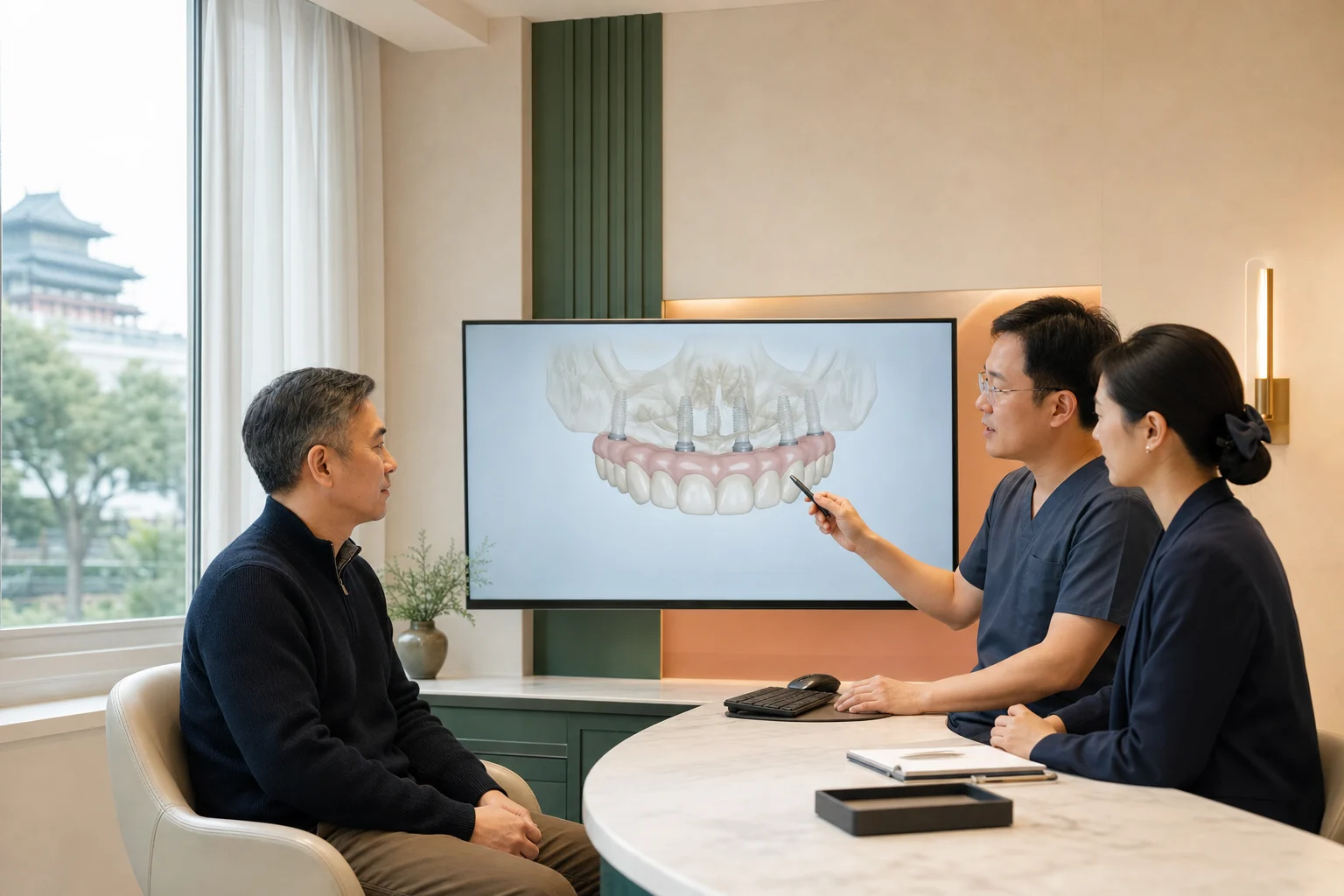
When most or all teeth in one jaw are missing, failing or no longer providing dependable function, patients often encounter the terms All-on-4 and All-on-6. These terms can be useful starting points, but they should not be treated as a pre-packaged answer. A full-arch implant plan has to account for the jaw, gums, bite, medical history, remaining teeth, hygiene needs, restorative space and the kind of bridge the patient will eventually live with. Our full-arch implant service in China helps international patients organise that conversation before travel, then connects it to a clinician-led assessment in Beijing.
China Dental Implants and Pinnacle Medical China coordinate patient-facing planning, practical questions and appointment logistics. Licensed partner clinicians remain responsible for diagnosis, suitability, treatment design, consent and clinical care. This is a meaningful distinction: the coordinator can help make a complex pathway understandable, but cannot decide whether four implants, six implants, a removable solution, a staged reconstruction or another option is appropriate for one person.
Full-arch care is a restorative plan, not an implant count
All-on-4 and All-on-6 are commonly used names for approaches that support a full-arch restoration with a defined number of implants. The final bridge, the way it meets the opposing teeth, access for cleaning, gum support, jaw anatomy and force distribution all matter as much as the number in the name. An implant-supported bridge may be one option among several; for some patients, retaining natural teeth, considering a removable denture or using another restoration may be the more appropriate clinical route.
That is why a full-arch consultation should start with the patient’s function and health, not with a promise of “fixed teeth in a day.” Our dental implant service overview explains the wider planning principles, including why remote information can be useful while the final treatment recommendation must wait for a proper examination.
Who may find this coordinated service useful?
The pathway may be relevant to adults with extensive tooth loss, failing bridges or crowns across one jaw, a denture that is difficult to stabilise, teeth that are no longer predictably restorable, or a wish to understand a proposed full-arch implant recommendation before making international travel arrangements. It can also help patients who have heard different implant counts suggested and want clearer questions rather than a quick online answer.
It is not an emergency service. Severe pain, facial swelling, trauma, uncontrolled bleeding, difficulty breathing or other urgent symptoms require local emergency assessment. For planned care, the first goal is to understand the clinical starting point and the options—not to force a complex rehabilitation into a fixed travel itinerary.
Step 1: assemble records that show the whole picture
Before travel, patients can share any recent panoramic imaging or CBCT data, photographs, a list of existing implants or prostheses, previous treatment plans, relevant medical and medication history, and a clear description of their concerns. Information about gum treatment, smoking or vaping, grinding, diabetes, osteoporosis medicines, blood thinners and past extractions may be important to the clinical discussion. The clinic may still require fresh imaging, scans or records after the patient arrives in Beijing.
It also helps to state practical priorities openly. Is the immediate concern chewing? Is it a loose denture, repeated breakage, visible failing teeth, travel timing, or the wish to avoid repeated short repairs? A useful preliminary review makes those constraints visible, but does not turn them into a diagnosis or a guarantee.
Step 2: confirm suitability through an on-site assessment
On arrival, the treating clinician may examine the teeth and gums, assess the bite and jaw relationship, review available bone and nearby anatomy, inspect any existing restorations, and consider general health factors. Digital scans, photographs, radiographs or three-dimensional imaging may be recommended according to the case. These findings can confirm a likely direction, change the implant count, introduce preparatory care or identify a better alternative.
The exact pathway cannot be inferred from a photograph or a general price list. Our All-on-4 / All-on-6 treatment pathway explains the potential stages, but the clinician’s assessment determines whether a full-arch implant plan is appropriate and what it should involve.
Step 3: plan the final bridge before any implant stage
A full-arch implant restoration is more than fixtures placed in bone. The restorative team needs to consider the final bridge shape, the smile and lip support where relevant, the amount of restorative space, speech, the opposing teeth, the planned bite and the ability to clean around the restoration. Digital scans, diagnostic models and planned tooth positions can help the patient and clinical team discuss the intended direction.
This is why the bridge design and surgical plan are linked. The surgeon, restorative dentist and laboratory team may need to work from the same information so that implant positions serve the final restoration rather than being planned in isolation. A digital plan supports communication; it is not a promise that every detail can be finalised before the clinician sees the actual tissues and bite.
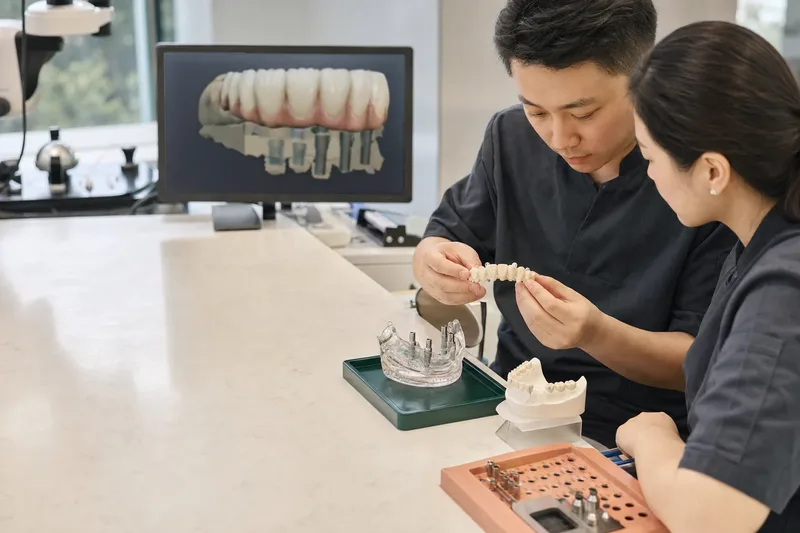
Step 4: understand what “immediate” may and may not mean
Some full-arch cases may be considered for a fixed provisional bridge soon after implant placement. Others may require a different sequence, a removable temporary solution, more healing time or further preparatory care. Immediate loading is a clinical decision that depends on factors such as stability, bone, bite, infection risk, general health, oral hygiene and the restorative plan. It is not a service guarantee that should be attached to a flight date.
Our earlier article, what may affect immediate-loading eligibility, explains why an apparently similar case can follow a different route after diagnosis. A responsible plan leaves room for a dentist to recommend caution where it protects the long-term result.
Step 5: allow time for review, healing and final restoration
Where a provisional stage is clinically appropriate, it can help the team review comfort, speech, bite, aesthetics and hygiene access before a definitive bridge is completed. It does not mean every patient receives the same temporary restoration or follows the same timeline. Some plans involve one coordinated treatment period; others have surgical and restorative visits separated by healing or review time.
Patients should therefore avoid booking return travel on the assumption that the first appointment fixes every stage. A realistic plan includes diagnostic time, the treatment window that the clinician recommends, any post-treatment review and sufficient flexibility if clinical findings change the sequence. The questions in our All-on-4 pre-travel checklist are a useful way to test whether a proposal explains both the provisional and final stages.
Documentation and maintenance remain part of the pathway
Before leaving Beijing, patients should ask the clinic what implant-system, component and restorative records it will provide, how follow-up is expected to work and what maintenance the bridge needs. An implant-supported bridge still needs regular cleaning and review. The treating clinician’s aftercare instructions are the patient’s primary guide, and a local dentist may be important for routine ongoing care after travel.
China Dental Implants and Pinnacle Medical China can help route non-urgent questions to the appropriate Beijing team and keep practical coordination clearer. We do not replace the treating clinician, provide an online diagnosis, approve a bridge design or promise how an individual case will heal.
Start with the full picture, not a predetermined implant count
You do not need to decide in advance whether All-on-4 or All-on-6 is the right route. Begin with the teeth or denture you are managing now, your available records, your general health context and your travel constraints. You can request a preliminary full-arch implant review; the next step is to clarify what can be discussed from records and what must wait for the licensed clinician’s in-person examination in Beijing.
This guide is general information, not a diagnosis or personal treatment recommendation. Seek advice from a licensed dental professional who can examine you.
Related patient guides
Immediate Loading After All-on-4: What May Affect Eligibility?
Immediate loading can be appropriate for selected cases, but it is a clinical decision rather than a travel package guarantee.
Read the guide →
All-on-4 in China: 12 Questions to Ask Before You Travel
Full-arch implant treatment is complex. These questions help international patients compare a proposed pathway beyond price.
Read the guide →
Dental Implant System Records: What Should You Receive?
Good implant documentation can make future maintenance and communication easier after you return home.
Read the guide →
Dental Implant Timeline in China: Why Some Cases Need Two Visits
The travel schedule for implants depends on biology, clinical stages and the final restoration—not only on flight dates.
Read the guide →