
Front Tooth Implants in China: Temporary-Tooth and Smile Planning
Explore clinician-led planning in China for a missing or failing front tooth, including records, temporary-tooth options, gum and bite assessment, and final crown coordination.

Losing a front tooth, or learning that one may not be restorable, is different from planning a back-tooth replacement. The tooth is visible when you smile and speak, while the gum line, neighbouring teeth and bite all affect what a future restoration can look and feel like. An implant may be one option, but it is not a product that can be selected from a photograph or a fixed online package. The clinical question is how to replace the tooth safely and appropriately for that individual mouth—and how to manage the space while treatment decisions are being made.
China Dental Implants and Pinnacle Medical China coordinate practical pre-travel planning for international patients seeking a front-tooth implant assessment in Beijing. Licensed partner clinicians are responsible for examination, diagnosis, imaging interpretation, surgical and restorative recommendations, consent and clinical treatment. We help organise records, appointment logistics and questions. We do not promise that a tooth can be removed and replaced with an implant on the same day, that a particular temporary option will be suitable, or that a final cosmetic result can be confirmed before an in-person assessment.
Why a front-tooth gap needs a restorative plan from the beginning
A front implant plan begins with the planned visible tooth, not only with the implant site. The treating team may assess the reason the tooth is failing or missing, the condition of the gums and bone, the position and health of adjacent teeth, smile line, tooth shape, shade, available space and the way the upper and lower teeth meet. A root fracture, active infection, gum disease, trauma, old crown, bite issue or thin gum tissue can change the options and sequence.
Our dental implant service overview explains why the implant, connector and final crown should be considered as one maintainable restoration. In the front of the mouth, the same principle also includes how the gum margin and neighbouring teeth are protected while treatment is progressing.
Temporary tooth does not always mean an immediate implant crown
Patients often ask, “Will I leave with a tooth?” That is an important question, but the answer is not one-size-fits-all. Depending on clinical findings, a clinician may discuss a temporary removable tooth, a bonded temporary solution, a temporary bridge, a provisional restoration attached to an implant, or a different route. Some temporary options are designed mainly to preserve appearance and space; others have different functional limits. The right choice depends on the site, planned treatment, bite forces, hygiene and the clinician’s instructions.
An immediate implant and immediate temporary crown may be considered in selected cases, but it is not a travel guarantee. If the socket, bone, gum condition, infection status, implant stability or bite do not support that approach, the clinician may recommend a staged route or another temporary solution. A good plan prepares for that possibility before treatment starts instead of treating it as a last-minute change.
Who may benefit from this coordinated service?
This service can be useful for adults with one missing front tooth, a damaged or failing front tooth, a front crown with an uncertain prognosis, or an extraction recommendation where future replacement needs to be discussed. It can also help patients comparing an implant with a resin-bonded bridge, a conventional bridge, a removable temporary tooth, orthodontic space management or no replacement. The best option depends on the teeth, gums, bone, bite, health history and personal goals—not only on whether an implant is technically possible.
It is not emergency care. Facial swelling, fever, trauma, uncontrolled bleeding, difficulty breathing or swallowing, severe rapidly worsening pain or a suspected spreading infection needs prompt local dental or medical assessment. Do not postpone urgent care while arranging international treatment. A remote records review cannot diagnose an acute infection or decide whether an extraction or another intervention is urgent.
What to send before you travel
Useful records may include recent dental X-rays or CBCT files where available, photographs of the smile and tooth, details of previous root-canal, periodontal or crown treatment, the reason a tooth has been judged failing, and notes about pain, looseness, swelling or bite changes. Please also share medical history, medications, smoking or vaping status, allergies and any previous implant or gum treatment. These materials help focus a conversation; they do not replace the clinic’s diagnosis.
Our implant records checklist for China explains how imaging, treatment history and health information can make an initial discussion more useful without locking anyone into a clinical plan. If an extraction has already been proposed, prepare questions about the tooth, the replacement space and the next decision point.
The Beijing assessment: scan, gums, bite and provisional together
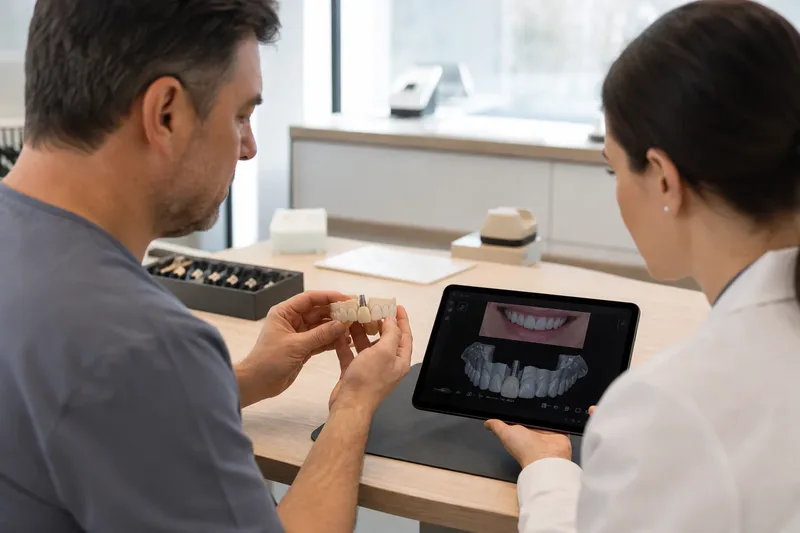
At the clinic, the treating team may examine the front tooth or gap, gum contours, neighbouring teeth, opposing teeth, bite contacts and the room for a natural-looking and cleanable replacement. New digital scans, radiographs or three-dimensional imaging may be recommended according to the case. The team may also review whether the tooth can be retained, whether extraction is indicated, whether an implant is appropriate, and whether a bridge or another alternative would better protect the rest of the mouth.
The temporary plan should be discussed alongside the final crown plan. A clinician may need to consider how a provisional shape affects the gums, how it stays in place, whether it should avoid certain bite contacts, and what will happen if a planned immediate approach is changed during treatment. This is why “a front implant with a temporary tooth” should be described as a clinician-led pathway rather than a standard package.
Questions worth asking before any procedure
Ask the treating clinician what problem the plan is solving, which findings make an implant appropriate or unsuitable, and what alternatives are reasonable in your case. Ask what temporary replacement is being considered, what it is intended to do, what care or food restrictions may apply, and what could make the plan change. You may also ask how gum condition, bite, adjacent tooth health and the final crown design affect the recommendation.
For a single-tooth implant, patients can compare this planning conversation with our single dental implant service guide. The purpose is not to decide treatment remotely; it is to arrive at a Beijing assessment with clear priorities and questions.
Do not let a flight date decide the clinical sequence
A front-tooth pathway can include assessment, tooth preservation or extraction decisions, a temporary replacement, implant placement where suitable, healing, digital records, crown design and delivery. Not every patient needs every stage, and the sequence cannot be safely promised before examination. If more than one visit is proposed, ask what information or healing response will be reviewed before the next step and which instructions should be followed after you return home.
Our two-visit implant timeline guide describes why surgical and restorative decisions may be separated. Travel plans should follow the confirmed clinical pathway, not the other way around.
Plan records and follow-up before you leave China
Before departure, ask what treatment summary, imaging, implant-system information, provisional or final restoration details, maintenance guidance and follow-up instructions will be provided. If a temporary solution remains in place, be clear about its intended role and who should be contacted locally for routine care or unexpected concerns. A local dentist may be important for ongoing care after travel.
China Dental Implants and Pinnacle Medical China can help route non-urgent practical questions to the appropriate Beijing team and support document and appointment coordination. We do not diagnose from photographs, perform procedures or guarantee how an implant, gum tissue or final crown will heal or look. Those decisions remain with the licensed treating clinicians after examination and informed consent.
Start with a front-tooth implant assessment
If you have a missing or failing front tooth and want to understand implant and temporary-tooth options in China, start with your records, health context and priorities. You can request a front-tooth implant planning conversation before travel. The next step is an informed Beijing assessment—not a promise of an immediate implant, a temporary crown, a final shade match or a fixed treatment timetable.
This guide is general information, not a diagnosis or personal treatment recommendation. Seek advice from a licensed dental professional who can examine you.
Related patient guides
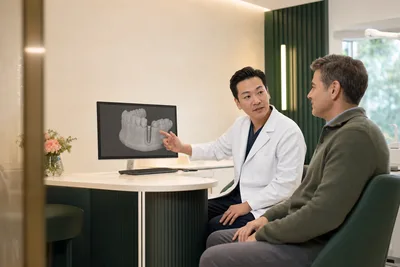
Single Dental Implant in China: A Coordinated Service for One Missing Tooth
See how a single dental implant service in China moves from records and Beijing assessment to implant planning, crown timing and follow-up.
Read the guide →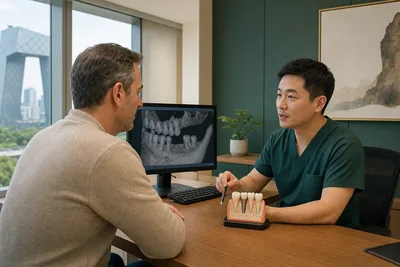
Replacing a Failing Tooth with an Implant in China: A Coordinated Planning Service
Learn how extraction-to-implant planning in China can move from records and a Beijing assessment to clinician-led options, restorative design and follow-up.
Read the guide →
What Dental Records Do You Need for Implants in China?
Use this pre-travel checklist to organise imaging, photos, health history and goals before an implant review in China.
Read the guide →
Dental Implant Timeline in China: Why Some Cases Need Two Visits
The travel schedule for implants depends on biology, clinical stages and the final restoration—not only on flight dates.
Read the guide →