
Porcelain Veneers for a Front-Tooth Gap in China: What to Assess First
A front-tooth gap can have different causes. Explore when porcelain veneers may be discussed, how bonding or orthodontics compare, and what to prepare for a China consultation.
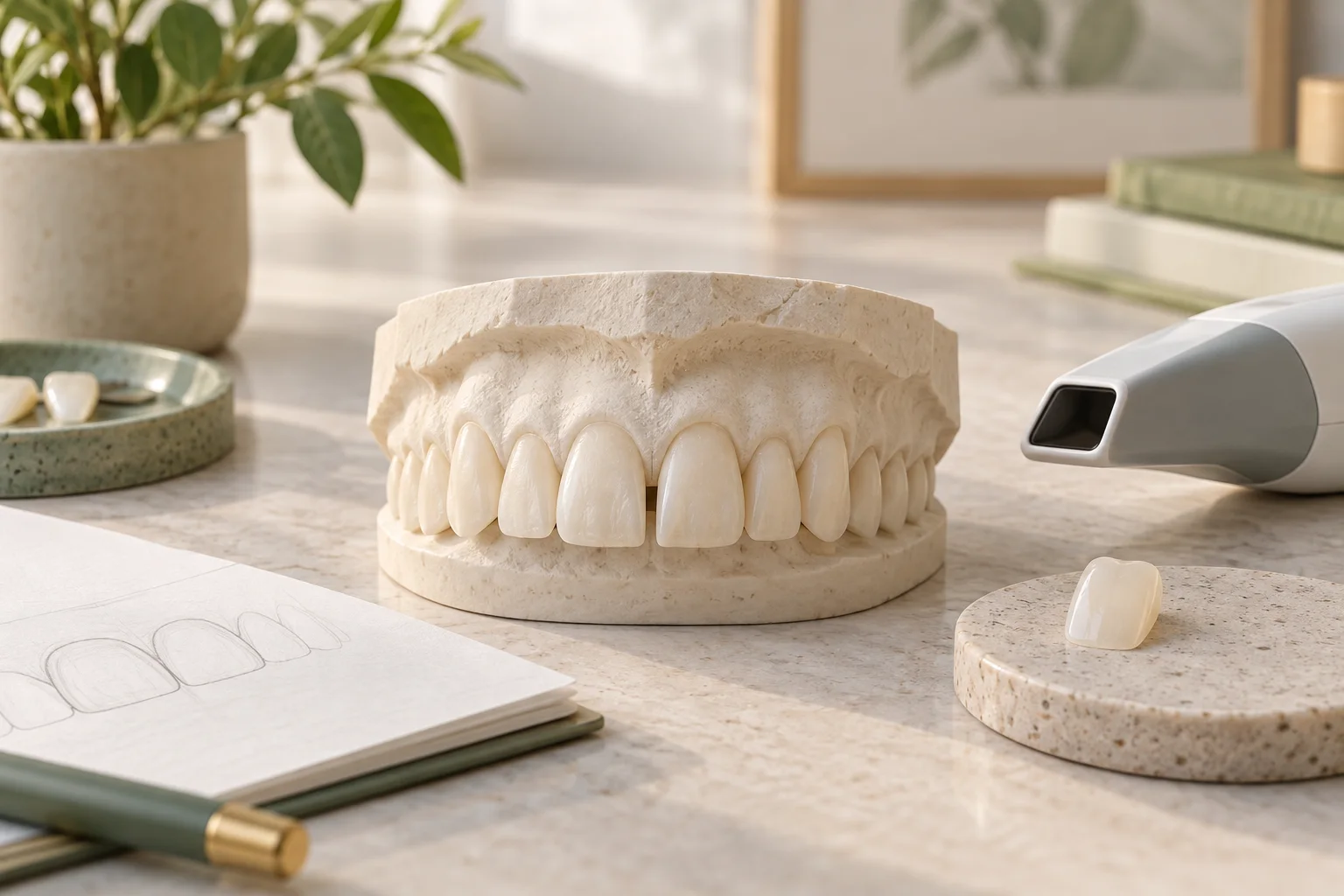
Images in this guide are AI-generated service illustrations, not photographs of our clinicians, patients or treatment results.
A small space between the two upper front teeth can be a feature you like, a change you have recently noticed, or the one detail you would prefer to alter in your smile. If you are thinking about porcelain veneers in China, the first service conversation should establish what the gap means for your teeth. Its cause and the condition of the surrounding teeth determine which options are sensible. A photograph can start that conversation, but it cannot finish it.
China Dental Implants helps international patients organise enquiries and appointments through Pinnacle Medical China and licensed partner clinics in Beijing. Our porcelain veneer service in China includes a clinician-led assessment of the teeth, gums, bite and aesthetic goals before a proposal is made. This guide shows what to ask when the main concern is spacing between front teeth.
First, say whether the gap is stable or changing
A long-standing space between otherwise healthy teeth may be mainly an aesthetic preference. A gap that has newly appeared or widened deserves a different conversation. Gum disease can reduce tooth support and allow teeth to move; other factors, including tooth size, tooth position or a missing tooth, may also be involved. Tell the dentist when you first noticed the space and whether its size has changed.
Share any bleeding, swelling, looseness, discomfort or change in the way your teeth meet. If a gap is growing or comes with those symptoms, arrange a dental evaluation rather than treating it as a routine cosmetic booking. Our gum-health planning guide explains why healthy supporting tissues matter before a final veneer decision. The treating clinician decides what examination or care is needed.
What would a veneer actually change?
A porcelain veneer is a custom-made ceramic covering bonded to the front surface of a tooth. On selected healthy teeth, a dentist may use veneers to change visible shape and proportions so a gap looks smaller or closes. That can be relevant when the teeth also appear small, uneven or discoloured. But the dentist must consider how the new width would look, where the contact between teeth would fall, and whether the result would be comfortable to clean.
Porcelain veneer treatment usually involves removing some enamel. The change is generally irreversible, and a veneer may eventually need repair or replacement. A gap alone does not justify preparing several otherwise healthy teeth. Ask which teeth the dentist proposes to treat, what each one would gain and how the plan affects future care. For broader planning of treatment extent, see our guide to the visible smile zone and veneer numbers.
Compare bonding and tooth movement before choosing ceramic
For a suitable small space, composite bonding may be discussed: tooth-coloured material is shaped directly on a tooth to change its outline. It can be a more conservative option in some cases and may be easier to repair, though its appearance and maintenance differ from porcelain. If spacing relates to tooth position or extends across several teeth, an orthodontic consultation may be more useful. Moving teeth addresses position rather than making teeth wider, but it follows a different timetable and has its own clinical considerations.
The choice is not always limited to one method. Some patients may need gum care first, orthodontic movement followed by a small restorative refinement, or no treatment if a stable gap causes no problem. Ask the clinician to explain what each option changes and what it leaves unchanged. Avoid using a digital image or a fixed package price as a substitute for that discussion.
Plan the shape of both teeth, not only the empty space
A balanced result depends on more than closing the visible line between the central incisors. The dentist may examine the width and length of both teeth, the neighbouring teeth, the gum outline, the way your lips frame the smile, and how the upper and lower teeth meet. A plan that closes one space could look unnatural if it makes the two front teeth disproportionately wide. It also needs to preserve access for cleaning.
Clinical photographs, scans, models or a trial design may help you discuss alternative shapes. If a mock-up is offered, use it to ask about tooth proportions, speech and the transition to untreated teeth. It communicates a proposed direction; it does not establish clinical suitability or guarantee the final appearance. Our article on trial smiles and veneer materials explains what a preview can help you review before final ceramics are made.
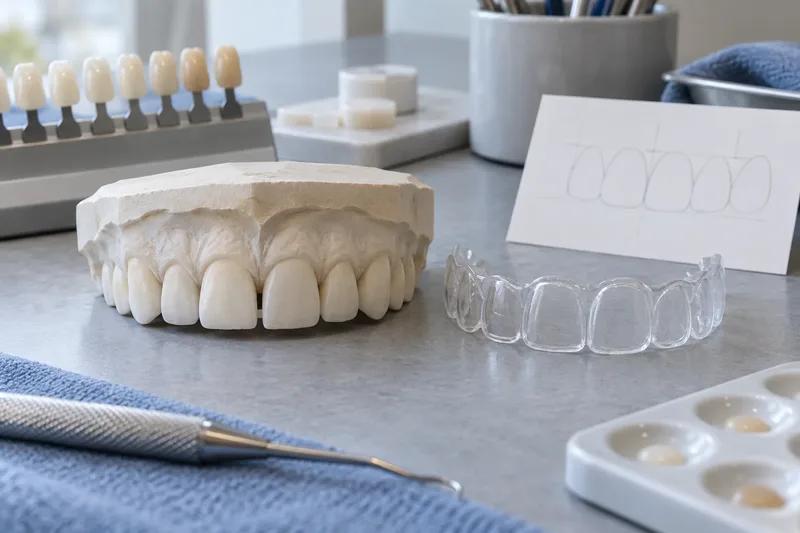
AI-generated illustration of a diagnostic model and a trial design; it does not show a real patient or treatment outcome.
Send useful information before travelling
For an initial enquiry, send recent, unfiltered photographs showing a relaxed smile, a broad smile and a close view of the front teeth if you are comfortable doing so. State whether the gap has always been present or is changing. Mention any previous orthodontic care, retainers, bonding, crowns or veneers, as well as known gum concerns. Existing dental records can help the clinic understand the question, but images and records may still need updating in person.
Tell the coordinator what you hope to achieve and whether preserving the current character of your smile matters. A useful note might be: “The gap has been stable for years. I would like to see whether it can look smaller without making the front teeth too wide.” That gives the dentist a more specific starting point than “close the gap.” Do not send highly sensitive records until the coordination team has explained the appropriate channel.
Understand the appointment and quotation sequence
The first Beijing appointment should allow the treating dentist to confirm the diagnosis, discuss alternatives and decide whether veneers are appropriate. If veneers are proposed, ask which teeth are included, whether a trial or temporary stage is planned, how impressions or scans and laboratory work will be arranged, and when shape and fit can be reviewed before bonding. Travel dates should leave room for findings that change the plan.
Request an itemised quotation that identifies the proposed work and any separate steps, rather than assuming that a number of veneers has already been established from photographs. Ask what happens if gum care, orthodontic advice or a revised design is recommended. Our role is to help organise the enquiry and appointment discussion. The licensed clinician makes the diagnosis, treatment decision and consent discussion.
Prepare for care after the visit
After placement, ask the clinic for cleaning instructions, the treatment summary and a contact route for concerns. Continue brushing with fluoride toothpaste, cleaning between teeth and attending regular dental examinations. Tell a dentist if your bite feels wrong, a restoration loosens, or the gums change. Future maintenance remains part of the decision to use veneers.
If you want to explore the options, request a front-tooth gap consultation and include your photographs, the history of the space and your preferred travel window. We can help the Beijing team understand your question before the visit. You can then decide with the treating dentist whether veneers, bonding, tooth movement or leaving the gap as it is best fits your situation.
Patient information sources
Clinical background was checked against Cleveland Clinic's information on diastema, the American Dental Association's patient guide to veneers and the American Association of Orthodontists' teeth-spacing overview. This editorial guide is general information and has not received an individual clinician's review. Your own assessment and treatment plan may differ.
This guide is general information, not a diagnosis or personal treatment recommendation. Seek advice from a licensed dental professional who can examine you.
Related patient guides
How Many Porcelain Veneers? Planning the Visible Smile Zone in China
Four, six, eight or another number? Learn why the visible smile, tooth condition, symmetry, existing restorations and long-term care matter more than choosing a veneer package.
Read the guide →
Porcelain Veneers in China: Trial Smiles, Materials and Timing
Aesthetic treatment is more reliable when the smile plan, materials, bite and review time are considered together.
Read the guide →
Porcelain Veneers in China: A Clinician-Led Smile Design Service
See how a porcelain veneer service in China moves from smile goals and records to clinical assessment, design review, ceramics and follow-up.
Read the guide →
Gum Health Before Implants or Veneers in China: Planning and Coordination
Understand why gum health, hygiene access and periodontal assessment matter before implant or veneer planning in China, with clinician-led options and follow-up coordination.
Read the guide →