
When an Old Crown or Bridge Fails: Restorative Review and Replacement Planning in China
A clinician-led restorative review service in China for patients with a failing crown or bridge, covering records, options, final design and follow-up.

An old crown or bridge can become a source of uncertainty long before a patient knows what the next treatment should be. A crown may chip, feel loose or hide a new problem in the supporting tooth. A bridge may be difficult to clean, lose support, fracture or no longer work comfortably with the bite. For an international patient, the question is often framed too narrowly: “Should I replace it while I am in China?” A safer starting point is to understand what is happening beneath and around the restoration, whether the supporting teeth can be kept, and which options are clinically reasonable after an in-person examination.
China Dental Implants and Pinnacle Medical China coordinate practical planning for international patients who need a restorative review in Beijing. Licensed partner clinicians are responsible for examination, diagnosis, treatment recommendations, consent and clinical care. Our role is to help make the record-sharing, appointment planning and service pathway clearer. We do not diagnose from photographs, promise that a crown or bridge can be saved, or decide remotely that an implant is the right replacement.
A crown or bridge problem is not automatically a replacement decision
Restorations can fail for many different reasons. The underlying tooth may have decay, a crack, root-canal concerns or inadequate remaining tooth structure. Gum inflammation, changes in the bite, grinding, a fracture in the ceramic or metal framework, loosened cement and changes in adjacent teeth can each change the discussion. A visibly damaged restoration can sometimes be repairable; in other situations, a new crown, a new bridge, treatment of the supporting tooth, a removable option, an implant-supported restoration or no immediate replacement may be considered.
That is why a restorative review begins with the cause rather than the material alone. The clinician needs to assess the teeth and gums supporting the restoration, the space, bite forces, hygiene access and the patient’s priorities. A plan to replace a crown may be quite different from a plan to replace a bridge that spans a missing tooth. If a supporting tooth cannot be predictably retained, the conversation may eventually include options described in our dental implant service overview, but an implant should not be presented as an automatic substitute for every failed restoration.
Who may benefit from this coordinated review?
This service may suit adults who have an older crown or bridge that feels unstable, has broken or chipped, has recurrent problems around it, looks mismatched after changes to nearby teeth, is difficult to maintain, or has been identified by their dentist as needing further assessment. It can also help someone whose existing plan is unclear: for example, a patient deciding between rebuilding a tooth, replacing a bridge or exploring an implant-supported crown after an assessment.
It is not a substitute for urgent local care. Facial swelling, fever, trauma, uncontrolled bleeding, difficulty breathing or swallowing, or severe rapidly worsening pain needs prompt local dental or medical assessment. Do not delay emergency treatment in order to arrange international travel. A remote planning conversation can identify records that may be useful, but it cannot establish the urgency of infection or the stability of a tooth.
Bring the history of the restoration, not only a smile photograph
A current smile photograph can be useful for communication, but it rarely shows the condition of the tooth, root or gum beneath a crown or bridge. Before travel, patients can share recent X-rays or CBCT files where available, photographs from several angles, the date and type of previous crown or bridge, prior root-canal or gum treatment, any laboratory or implant-system documents, and a short description of changes in comfort, chewing or appearance. Medical history, current medicines, smoking or vaping, clenching and grinding, and plans for return follow-up can also shape the clinical conversation.
Records help the clinic prepare the right questions; they do not lock in a diagnosis before the appointment. When an implant-supported restoration is part of the history, component and restoration records can be especially helpful. Our guide to implant system and component records explains why treatment documentation matters if the team needs to understand an existing restoration or plan a later stage.
The Beijing assessment: diagnose first, design second
At the clinic, the treating dentist may examine the crown or bridge margins, the teeth that support it, gum health, bite, neighbouring teeth and the opposing arch. New photographs, digital scans and radiographs may be recommended; the exact imaging depends on what needs to be clarified. The examination may confirm that a new restoration is appropriate, identify a reason to treat the supporting tooth first, show that a bridge design needs to change, or make a non-implant option more suitable than the patient expected.
When a visible front tooth is involved, the discussion can include how a new crown or bridge relates to tooth shade, proportions and the surrounding smile. That is different from assuming that a cosmetic surface treatment solves a structural problem. Porcelain veneer planning may be relevant for selected visible teeth with sufficient healthy structure, but it is not a replacement for diagnosing a compromised crown, bridge or supporting tooth.
Compare options through the final restoration
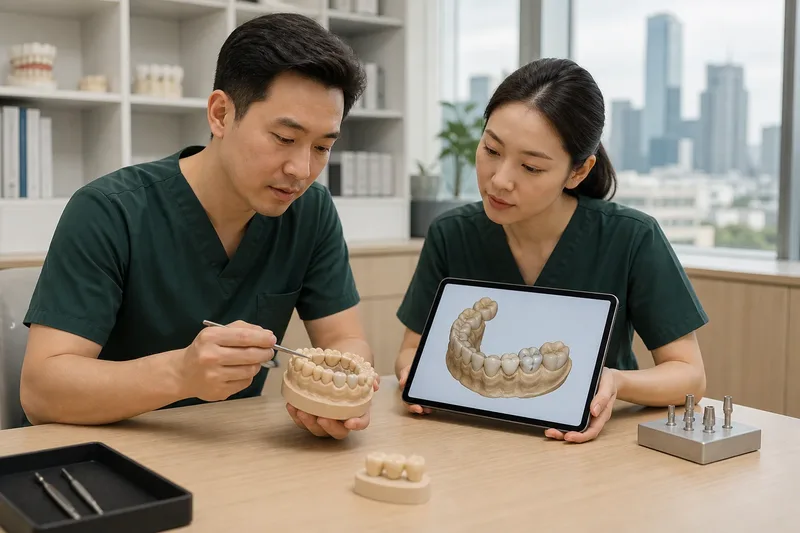
A useful consultation does not only ask, “What can be done today?” It asks how the proposed final tooth or teeth would be supported, cleaned, repaired and reviewed. With a bridge, the quality and condition of the supporting teeth, the length of the span, the bite and the ability to keep the margins clean are all important. If a missing tooth is being replaced after a supporting tooth is removed, an implant-supported crown might be discussed only after the clinician has assessed the site, available bone and gums, health factors and the restorative position.
For a single missing tooth, implant treatment involves linked surgical and restorative decisions after a confirmed diagnosis. If the problem concerns a visible ceramic restoration rather than a tooth that must be replaced, patients can also compare the clinical questions in our guide to replacing porcelain veneers in China. The correct route is case-specific, and the clinician may recommend repair, re-treatment, replacement, staged care or a different option altogether.
Allow room for staged care and a temporary solution
Travel should fit a clinical plan, not force a plan to fit one flight itinerary. Some crown or bridge cases can be completed after the necessary assessment and laboratory work; others may require treatment of decay or gums, root-canal evaluation, a provisional restoration, healing after extraction or a separate surgical and restorative sequence. If the clinician proposes a temporary crown, bridge, retainer or other provisional option, ask what it is intended to do, what it cannot guarantee and what care is needed while a final decision or later stage is pending.
This is especially important when a failed bridge reveals an issue with a supporting tooth. A staged approach can make it possible to reassess the gums, bite or healing before the final design is fixed. Our follow-up after dental treatment in China guide explains the value of taking treatment information home and arranging appropriate routine care rather than treating a completed trip as the end of maintenance.
What coordination can help organise
For non-urgent cases, China Dental Implants and Pinnacle Medical China can help collect preliminary records, explain what the Beijing team may need before the first visit, coordinate appointment timing, and help patients ask for the clinic-issued documents that support later care. We can also help make it clear whether the current discussion is about a review, preparatory treatment, a provisional stage or a final restoration.
Coordination does not replace the clinician’s responsibility to decide whether a tooth is restorable, whether removal is appropriate, whether an implant is suitable, or which restorative material and sequence should be used. Those decisions depend on the actual examination, imaging, health information and informed consent. No online review can guarantee a final price, timeline, tooth-retention outcome or cosmetic result.
Start with a clear clinical question
If an old crown or bridge no longer feels dependable, begin by describing what has changed and gathering the records you already have. You can request a restorative review coordination conversation before travel. The purpose of that first step is to organise an informed consultation in Beijing—not to predetermine a crown replacement, bridge replacement or implant treatment before the treating clinician has assessed you in person.
This guide is general information, not a diagnosis or personal treatment recommendation. Seek advice from a licensed dental professional who can examine you.
Related patient guides
Replacing a Failing Tooth with an Implant in China: A Coordinated Planning Service
Learn how extraction-to-implant planning in China can move from records and a Beijing assessment to clinician-led options, restorative design and follow-up.
Read the guide →
Replacing Porcelain Veneers in China: A Coordinated Smile Refresh Service
Understand how a porcelain veneer renewal service in China can move from existing records and a Beijing assessment to an individual ceramic and follow-up plan.
Read the guide →
Dental Treatment Follow-Up After You Return Home
Good follow-up starts with records, realistic expectations and knowing when local urgent care is appropriate.
Read the guide →
Dental Implant System Records: What Should You Receive?
Good implant documentation can make future maintenance and communication easier after you return home.
Read the guide →